
Cardano staking · Gero Dashboard 2.7.1
Best wallet to stake ADA: no lock-up, any pool.
Stake ADA from GeroWallet and it never leaves your wallet. Delegate to any of 3,000+ Cardano pools, or to the official Gero pool, from a software wallet or a Ledger, Trezor or Keystone, and watch rewards land every epoch.
- No lock-up, ever
- 3,000+ pools
- Ledger, Trezor and Keystone
[GERO] A.D. Labs
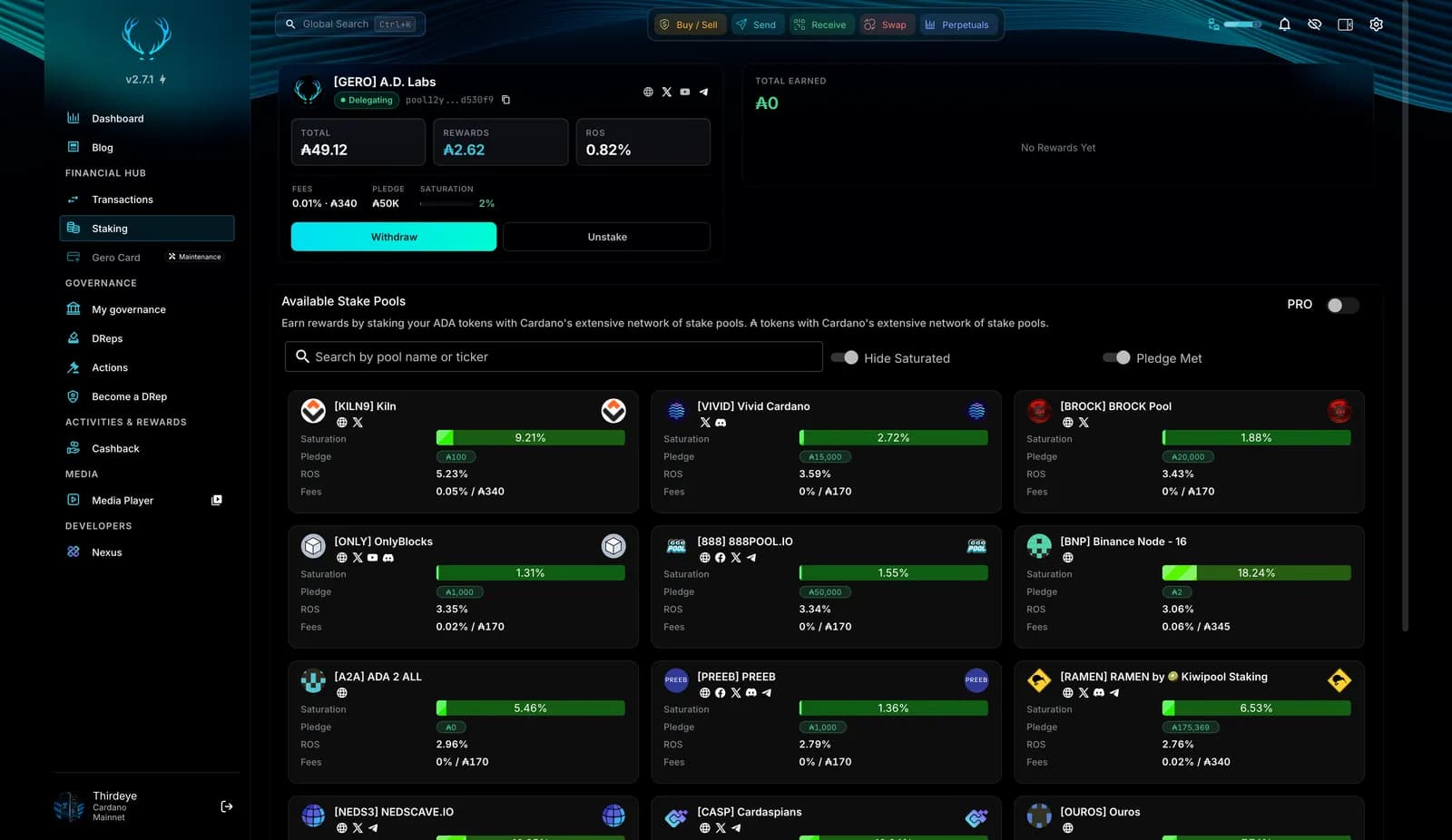
The staking page
Your delegation and every pool, on one page
Rebuilt in 2.7 around one card that tells you what your stake is doing, with the whole pool register underneath.
- One delegation card with your pool, total stake, rewards, return on stake, fees, pledge and saturation, and Withdraw and Unstake right there.
- Every registered pool searchable by name or ticker, with Hide saturated and Pledge met filters and a Pro view for the full numbers.
- Pending until it lands. A delegation shows as pending while the transaction confirms, so there is no wondering whether it went through.
- Rewards graph that fills in epoch by epoch, and a total earned figure for the wallet.
Rewards
How Cardano staking rewards work
Cardano staking is delegation, not lending. Your ADA never moves, and the rewards come from the protocol.
- Rewards arrive every epoch, every five days, once your delegation is active. The first payout lands after about 15 to 20 days, then continuously.
- The rate is set by the protocol and the pool, not by GeroWallet: it depends on the reward schedule, the pool’s performance and how close it is to saturation. GeroWallet shows each pool’s return on stake from its own history, so you compare real figures, not a quoted APY.
- No lock-up. Staked ADA stays in your wallet and stays spendable. Send it, swap it or move pool whenever you like; only a 2 ADA registration deposit is held, and it comes back when you unstake.
- To withdraw rewards, your stake needs a governance position. Delegate to a DRep, or choose Abstain or No Confidence, in one transaction from My governance; the staking page tells you when withdrawals are locked.
Official pool
The official GERO pool, one of 3,000+
A.D. Labs runs the GERO stake pool. Delegating to it supports GeroWallet development, and it sits in the pool list like any other, with the same numbers next to it. You are never nudged toward it.
Verify the pool on Cardanoscan[GERO] A.D. Labs
Cardano mainnet stake pool
- Ticker
- GERO
- Operator
- A.D. Labs, the team behind GeroWallet
- Margin
- 1%
- Fixed cost
- 340 ADA per epoch, the network minimum
- Pledge
- 50,000 ADA
More about staking in GeroWallet
Hardware wallets
Delegate from a Ledger, Trezor or Keystone. The certificate is shown and signed on the device, so your keys never touch the browser. Trezor connects over WebUSB with no Bridge to install.
Several wallets, several pools
Each wallet or account in GeroWallet delegates on its own. Spread your stake across pools, or keep one wallet on the official pool and another wherever you like.
Run your own pool
GeroWallet 2.7 added a Stake Pool Operator dashboard: a guided setup for Ledger and software keys, pool updates with side panel signing, and a node monitor connection. Rolling out behind a feature flag.
Step by step
How to Stake ADA in GeroWallet
- 01
Open Staking
Open GeroWallet and choose Staking from the Financial hub. The page shows your current delegation, if any, and every registered pool below it.
- 02
Choose a pool
Search by name or ticker, hide saturated pools, and compare return on stake, pledge, fees and saturation. The official GERO pool is one option among 3,000+.
- 03
Delegate
Press Delegate and confirm in the wallet or on your Ledger, Trezor or Keystone. A small network fee applies, the 2 ADA deposit is refundable, and your ADA stays in your wallet.
- 04
Watch the rewards
The delegation shows as pending until it confirms. Rewards start after about 15 to 20 days and the graph tracks them every epoch. Withdraw whenever you like.
Cardano staking questions
What is the best wallet to stake ADA?
The one that keeps your ADA in your own wallet with no lock-up, lets you pick any pool with real performance numbers, signs on a hardware device when you have one, and shows you rewards as they land. GeroWallet does all four: non-custodial staking to any of 3,000+ pools, Ledger, Trezor and Keystone support, a rewards graph, and a pending state so you know the delegation went through.
What is the Cardano staking APY?
It is not a fixed number. Rewards depend on the protocol’s reward schedule, the pool’s performance and its saturation, and they change every epoch. Rather than quote a rate that will be wrong next month, GeroWallet shows each pool’s return on stake computed from its own history, so you can compare pools on what they actually paid.
How much can I earn by staking ADA?
Rewards are paid in ADA every epoch, every five days, and scale with the amount you delegate and the pool’s performance. GeroWallet shows each pool’s recent return on stake before you delegate, and your own rewards on the delegation card once you have.
Is there a minimum amount required to stake?
No. You can stake any amount of ADA. A 2 ADA deposit is held when you register your stake key for the first time, and it is returned when you unstake.
Can I unstake my ADA at any time?
Yes. Cardano staking has no lock-up. Staked ADA stays in your wallet and can be sent, swapped or used in governance at any time, and you can change pool or unstake whenever you like.
Are there any fees for staking?
GeroWallet charges nothing for staking. You pay the standard Cardano network fee, typically around 0.17 ADA, when you delegate. Pools take their fee from the rewards before they are paid out; the official GERO pool takes a 1% margin plus the 340 ADA fixed cost every pool charges per epoch.
What is the official GERO stake pool?
GERO is the stake pool run by A.D. Labs, the team behind GeroWallet, with a 1% margin, the 340 ADA network minimum fixed cost and a 50,000 ADA pledge. Delegating to it supports GeroWallet development. It is listed in the wallet like every other pool and you can verify it on Cardanoscan.
How do I choose the best stake pool?
Look at return on stake over recent epochs, saturation (avoid pools near or over the limit), the margin and fixed cost, and the pledge. GeroWallet shows all of these for every pool, with Hide saturated and Pledge met filters and a Pro view with the full figures.
Can I participate in governance while staking?
Yes, and you should: staked ADA carries the voting power you delegate to a DRep, and reward withdrawals stay locked until your stake has a governance position. My governance sets that up in one transaction.
Can I stake ADA from multiple wallets?
Yes. Each wallet or account delegates independently, so you can manage several wallets in GeroWallet and stake each one with a different pool.
Can I stake from a Ledger, Trezor or Keystone in GeroWallet?
Yes. Pair the device with GeroWallet and delegate from it like any other wallet. The delegation certificate is shown on the device screen and signed there, so your keys never leave the hardware. Trezor connects over WebUSB with no Bridge to install.
Can I run my own Cardano stake pool from GeroWallet?
GeroWallet 2.7 added a Stake Pool Operator dashboard: a guided pool setup for Ledger and software keys (cold key and VRF), pool update flows with side panel signing, guards against fund loss on retries, and in 2.7.1 a connection to token-protected node monitor agents. It is rolling out behind a feature flag, so not every wallet sees it yet.
Does staking work on Midnight too?
Midnight uses a different mechanism. Instead of delegating, you hold NIGHT, or cNIGHT in your Cardano wallet, and it generates DUST, the resource that pays for private transactions. GeroWallet handles DUST generation in-wallet with no bridging; see the Midnight wallet page.
Staking is one part of the wallet
Governance
Your staked ADA carries the voting power you delegate to a DRep.
Swap
Staked ADA is still spendable. Swap it on Gero’s own aggregator any time.
Market data
Every Cardano DEX in one table, with charts and order books.
Cardano wallet
The wallet around your stake: Midnight, hardware wallets and public source code.
Stake ADA without giving it away
Free on Chrome, Brave and Edge. Non-custodial, public source code, hardware wallet ready.